What Is a Knock On in Rugby: Laws, Exceptions and Tips

Lacing up my boots for my first competitive season, the absolute hardest habit to break was avoiding forward slips. Learning what is a knock on in rugby completely transformed how I approached every catch under pressure, saving our backline from constant turnovers.
Key Takeaways
- A knock-on occurs when a player drops or hits the ball forward toward the opponent’s goal line using hands or arms.
- The standard restart after an accidental knock-on is a scrum awarded to the non-offending team.
- Intentional knock-ons trigger severe sanctions, including yellow cards, penalties, or potential penalty tries.
- Blocked kicks (charge downs) and stripping the ball backward are notable legal exceptions to the rule.
- Clean handling technique and soft wrists drastically reduce costly turnover errors during high-speed play.
Knock On in Rugby Keeps the Game Fun
Understanding what is a knock on in rugby keeps match day exciting because it explains the exact flow of physical play. Without this crucial boundary, games would turn into messy chaotic free-for-alls instead of strategic battles for space. Mastering this simple rule lets you celebrate massive turnover tackles, smart tactical kicks, and clever team set pieces like a seasoned professional!
What Is a Knock On in Rugby Explained
Rugby law centers around spatial awareness, territorial control, and strict backward ball movement.
Core Definition and Basic Mechanics
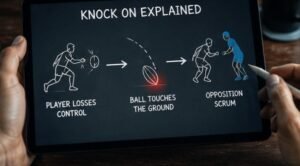
Understanding the fundamental mechanics of a knock-on helps players avoid basic handling errors. A knock-on happens when a ball carrier loses possession, drops the ball, or strikes it with their hand or arm, sending it toward the opponent’s dead-ball line. The referee blows the whistle the moment the ball touches the turf or makes contact with another player. If you fumble the ball into the air but catch it before it touches anything else, play continues seamlessly.
Forward Trajectory Restrictions
The backward pass mandate creates the structured offside line that defines rugby’s tactical beauty.
Passing or fumbling forward breaks the defensive wall structure and gives an unfair spatial advantage. By penalizing forward slips, World Rugby forces teams to earn every yard through disciplined footwork, tight support lines, and clean hands. This creates clear boundaries between offensive progression and defensive recovery.
Accidental vs Deliberate Knock-On Rules
Referees distinguish between a simple skill error and a tactical cynical infraction.
Accidental Drops and Fumbles
Most handling errors occur during high-speed passing sequences or aggressive defensive tackles. When a winger spills a pass in wet weather, it is classified as an accidental knock-on. The official halts the match and grants a scrum restart to the opposing squad. These basic mistakes are part of match play, carrying no disciplinary warnings or direct penalty kicks.
Intentional Knock-Ons and Penalties
Intentionally slapping down an opponent’s pass to halt an attack carries severe consequences. If a defender reaches out with one hand to slap a pass away without a realistic chance of catching it, referees penalize the offense immediately.
The offending player frequently receives a yellow card, sending them to the sin bin for ten minutes. If the slap denies a clear scoring attempt, the referee awards an automatic penalty try.
Major Exceptions to the Rule
Not every ball travelling forward off a player’s arm or body counts as an infringement.
Charge Down Rules
Blocking an opponent’s kick is one of the most exciting defensive efforts in sports.
When a rushing defender leaps to block an opponent’s kick, the ball often bounces off their hands or arms and flies forward. World Rugby Law explicitly deems this a charge down rather than a knock-on. Play continues without interruption, allowing the defender to scoop up the ball and score.
Ripped Balls and Body Bounces

Defensive tackles can complicate possession calls near the breakdown.
If a defender strip-tackles or legally rips the ball out of an attacker’s grip, causing it to fall forward from the ball carrier, it is not penalized against the defender. Similarly, if the ball hits a player’s chest, head, knee, or foot and travels forward, play carries on. Only contact with the hands or arms triggers the knock-on restriction.
| Situation | Contact Point | Direction of Travel | Referee Signal | Game Restart |
| Accidental Drop | Hand / Arm | Forward | Arms rolling over | Scrum to Opposition |
| Intentional Slap | Hand / Arm | Forward | Arm pointed to mark | Penalty Kick / Card |
| Charge Down | Hand / Arm | Forward | Play On signal | Continuous Play |
| Knee / Foot Bounce | Legs / Feet | Forward | Play On signal | Continuous Play |
Practice Tips for Avoid What Is a Knock On in Rugby Errors
Improving catching mechanics under pressure eliminates costly mistakes during match play.

Step one requires framing your hands properly by forming a wide target with thumbs touching before receiving the pass. This builds muscle memory for clean catches every time.
Step two focuses on receiving the ball with soft, yielding wrists rather than stiff arms to absorb impact velocity smoothly. Soft hands naturally cushion the ball and secure possession.
Step three emphasizes turning your chest slightly toward the passer to ensure any potential loose drop spills backward onto your own side. This guarantees safety if the ball slips.
Step four incorporates contact drills where support players push against you during high-velocity catching sessions. Practicing under physical pressure builds confidence for official game days.
Frequently Asked Questions
1. What does a knock-on in rugby mean?
A knock-on means a player loses control of the ball, knocking it forward with their hand or arm toward the opponent’s end zone before it hits another player or the ground.
2. What is the difference between a forward pass and a knock on?
A forward pass is an intentional throw to a teammate moving forward, whereas a knock-on is an accidental drop or fumble off the hands travelling toward the opponent’s goal line.
3. What happens after a knock-on?
The referee blows the whistle to stop play and awards a scrum to the non-offending team at the spot where the fumble occurred, unless advantage applies to the defenders.
4. Is a knock-on always a scrum?
No, an accidental knock-on results in a scrum, but an intentional knock-on results in a penalty kick for the opposing team and potentially a yellow card or penalty try.
Winning the Game Without Fumbling standard
Mastering what is a knock on in rugby helps both new players and avid fans appreciate game flow, referee decisions, and team strategies. Clean handling keeps attacks dynamic while avoiding unnecessary scrums or discipline issues. Sharpen your catching fundamentals today, practice tight support runs, use rugby kits bags and keep your squad moving toward the try line!