Rugby 101: How to Score Points in Rugby Effortlessly

Sitting on the couch watching a high-stakes match left us completely baffled by the scoreboard at first. Discovering how to score points in rugby transformed the experience from confusing chaos to absolute edge of your seat excitement.
Understanding the scoreboard is easier than it looks. Unlike American football, where crossing the goal line guarantees points, rugby demands hands on execution right down to the grass.
Key Takeaways
- Learning rugby scoring makes watching games infinitely more exciting.
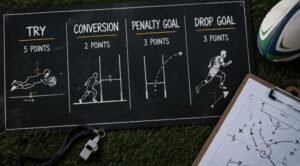
- Scoring options include tries, conversions, penalty kicks, and drop goals.
- Rugby Union and Rugby League use unique scoring systems.
- Grounding the ball with firm pressure is mandatory for tries.
Understanding Rugby Scoring Is Key
Unlocking how to score points in rugby turns a chaotic swarm of physical tackles into a thrilling high speed tactical chess match. Spotting why referees signal points or wave off dynamic plays elevates your viewing experience instantly. You can easily impress fellow fans, follow intense global tournaments with confidence, and truly appreciate every clever strategic kick on the pitch.
Decoding Rugby Union Scoring Breakdown
Rugby Union features five distinct ways to change the scoreboard throughout an exciting eighty minute match.
Grounding the Ball for a Five Point Try
Crossing the goal line represents only half the battle during live match play. Players must actively exert downward physical pressure onto the ball inside the opponent’s in-goal area to validate a five point try. Simply holding the ball above the turf while stepping across the line leaves the overall score completely unchanged.
Adding Two Points with the Conversion Kick

Earning a try grants the scoring squad an immediate opportunity to attempt a conversion kick worth two additional points. The kicker lines up perpendicular to the exact spot where the ball touched down inside the try zone. Taking shots closer to the sidelines creates sharper, highly challenging angles toward the goal posts.
Punishing Offenses with Three Point Penalties
Major infractions committed by defending teams yield penalty kick strategies for opposition offenses. Captains often point directly toward the uprights to claim three manageable points off a kicking tee. Consistent penalty conversions frequently decide low scoring international matches.
Striking Open Field Drop Goals
Attacking teams can launch a drop goal worth three points at almost any time in open play. Players must deliberately let the oval ball bounce off the turf right before kicking it straight between the uprights. It serves as a clutch tactic when trailing late near the final whistle.
Automatic Seven Points for Penalty Tries
Referees award a penalty try worth seven points when defensive foul play directly prevents a guaranteed score. The team receives full points immediately without needing to attempt a conversion kick. It penalizes illegal defensive tactics near the goal line sternly.
Comparing Points Across Rugby Union and Rugby League
Navigating between the two major codes of the sport reveals noticeable differences in overall point distribution.
Lowering the Try Value in League
Rugby League awards four points for a try rather than the five points granted in Rugby Union. This structural reduction encourages continuous ball movement across set counts of six tackles.
Modifying Drop Goals and Penalties

Drop goals in Rugby League earn just a single point, keeping teams focused on scoring tries. Penalty kicks yield two points in League, maintaining a clear point gap between field shots and grounding the ball.
How to Score Points in Rugby During Live Matches
Executing high scoring attacking plays requires smart positioning, quick distribution, and sharp kicking strategies.
Mastering the mechanics of scoring starts with strategic field position. Attackers work the ball deep inside the opposition twenty two meter zone through clean passing and relentless rucking. Forward packs usually push straight through defensive lines using rolling mauls from lineouts. Meanwhile, fast backline players exploit open space along the sidelines to dive across the corner of the in goal area.
Kickers play an equally crucial role in building steady momentum. When defenders commit dangerous breakdown fouls, taking the quick three points keeps the scoreboard moving forward. In tight open play, fly halves set their feet, drop the ball to the turf, and snap through a drop goal to catch defenders completely off guard. Balancing physical carries with disciplined kicking secures victories.
Essential Rules Influencing Every Score
Key field rules strictly dictate whether a scoring attempt stands or gets called back by match officials.
The Strict Backward Passing Requirement
Carrying the ball forward is fully permitted, but passing it forward with hands is strictly illegal. Throwing a forward pass immediately halts play and awards the opposition a scrum restart.
Avoiding the Costly Knock On Infringement
Fumbling or dropping the ball forward toward the opponent’s dead ball line triggers a knock on penalty. Losing control of the ball while attempting to ground a try cancels out the score completely.
Frequently Asked Questions
1. How do they score points in rugby?
Teams learn how to score points in rugby by touching the ball down in the opponent’s in-goal area for a try. They also score points by kicking the ball through goal posts via conversions, penalties, or open-play drop goals.
2. What are the 4 ways to score in rugby?
The four standard ways to score in rugby union are a try, a conversion kick, a penalty goal, and an open-play drop goal. Penalty tries also award automatic points for severe defensive fouls.
3. What are the 5 basic rules of rugby?
Pass only backward, ground the ball firmly to score, release immediately after being tackled, stay onside during rucks, and avoid dangerous high tackles across all levels of play.
4. How to calculate rugby points?
Add 5 points for each try, 2 points for every successful conversion, 3 points for penalty goals, and 3 points for drop goals. Penalty tries count as automatic 7-point scores.
Score Big on Rugby Day with Your New Expertise!
Understanding how to score points in rugby brings incredible excitement to every fixture you watch. Whether you are tracking a dynamic five point try or celebrating a game winning drop goal from deep, knowing these core rules makes following the action seamless. Grab your jersey, tune into the next big match, and enjoy every single point scored on the pitch!