Speed and Agility Drills for Women’s Rugby Players

The best speed and agility drills for women’s rugby players do more than create fast feet. They teach athletes to accelerate into space, stop under control, track opponents, change direction, and explode again without losing balance.
I follow one rule when planning these sessions: brake before you boost. A player who cannot decelerate effectively will struggle to cut sharply, regardless of her straight-line speed.
Why Rugby Speed Requires More Than Fast Running
Rugby speed includes acceleration, maximum velocity, deceleration, reacceleration, change of direction, and reactions to opponents.
World Rugby distinguishes planned change-of-direction training from true agility. Planned drills follow a known route. Agility also requires visual scanning, anticipation, pattern recognition, and decision-making.
This distinction shapes my training approach. Cone drills teach players how to move. Partner and game-based drills teach them when and where to move.
Deceleration deserves equal attention. World Rugby identifies braking mechanics, body position, and foot repositioning as key foundations for female rugby agility performance.
Best Speed and Agility Drills for Women’s Rugby Players
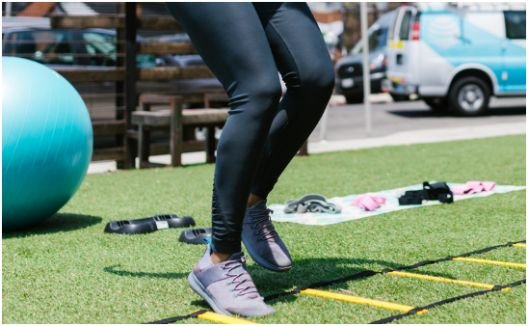
These speed and agility drills for women’s rugby players address the movement patterns most often needed during open play.
Falling Starts
Stand tall with the feet hip-width apart. Keep the body straight and lean forward from the ankles. Sprint as soon as balance breaks.
I use falling starts to teach forward projection and an aggressive first step. The athlete should push backward into the ground instead of standing upright immediately.
Complete four to six sprints over 10 to 15 yards. Rest for 60 to 90 seconds between repetitions.
5-10-5 Pro Agility Drill
Place three markers five yards apart. Start beside the middle marker, sprint five yards, turn and run ten yards, then turn again and finish through the center.
The drill develops lateral acceleration, controlled braking, 180-degree turning, and rapid reacceleration.
Players should lower their hips before the turn. Reaching too far with the plant foot can reduce control and delay the next acceleration.
L-Drill
Arrange three cones five yards apart in an L shape. Sprint forward, turn around the second cone, weave around the third, and accelerate through the finish.
The L-Drill combines linear speed with tight 90-degree cuts. It suits centers, wings, fullbacks, and loose forwards who regularly alter running lines at pace.
Perform three or four repetitions in each direction.
Mirror Drill
Two players face each other inside a five-yard box. One player leads while the other mirrors every lateral movement for five to eight seconds.
This is one of my preferred speed and agility drills for women’s rugby players because it includes perception and reaction. The defender must read the leader’s hips, shoulders, and movement speed rather than follow a memorized route.
Research shows that reactive agility creates different movement demands from pre-planned cutting. Both qualities should therefore appear in rugby training.
W-Run
Set five cones in a W pattern. Sprint diagonally toward the first cone, plant, retreat toward the next point, and drive forward again.
The W-Run recreates defensive drift, retreat, and recovery actions. Players should keep their chest controlled while backpedaling and avoid crossing their feet unnecessarily.
Quick Drill Selection Table
| Drill | Main quality | Rugby application | Suggested volume |
| Falling start | First-step acceleration | Support runs and defensive chases | 4–6 × 10–15 yards |
| 5-10-5 | Braking and 180-degree turns | Breakdown recovery and defensive reloads | 3–5 repetitions |
| L-Drill | 90-degree cutting | Evasion and changing support lines | 3–4 each direction |
| Mirror drill | Reactive agility | One-on-one defending | 4–6 × 5–8 seconds |
| W-Run | Multidirectional movement | Drift defense and recovery | 3–5 repetitions |
Keep the volume low enough to preserve speed. The session has become conditioning when fatigue changes posture, foot placement, or reaction time.
Two-Day Weekly Speed and Agility Plan
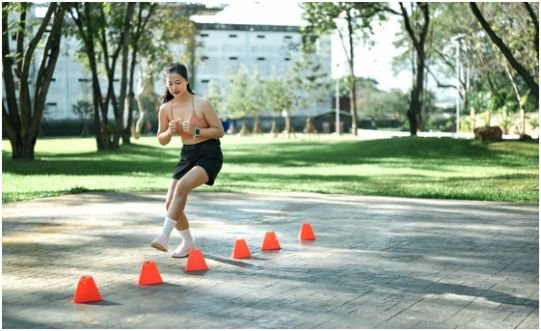
I schedule speed and agility drills for women’s rugby players twice weekly. One session develops linear acceleration. The other targets braking, cutting, and reactive movement.
Session One: Acceleration and Linear Speed
Begin with dynamic mobility, marching drills, skips, and progressive runs.
Use this sequence:
Falling starts: four repetitions over 10 yards
Three-point starts: four repetitions over 15 yards
Build-up runs: three repetitions over 25 yards
Full sprints: three repetitions over 30 yards
Rest for one to two minutes between hard efforts. Increase the recovery period when sprint speed or technique begins to decline.
World Rugby recommends developing acceleration posture, stride mechanics, and force application so players can create forward momentum efficiently.
Session Two: Cutting and Reactive Agility
Begin with a controlled braking exercise. Sprint ten yards, lower the center of mass, and stop inside a marked zone.
Progress to the 5-10-5, L-Drill, and mirror drill. Finish with a small-sided chase, evasion, or defensive tracking game.
My preferred order is planned, reactive, then game-based. The player first learns the movement. She then reacts to another player. Finally, she applies the skill while solving a rugby problem.
World Rugby recommends a comparable progression from foundational mechanics to game-embedded agility.
Pair this work with in season strength training for women’s rugby players. Strength supports force production and absorption, but sprinting and deceleration still require dedicated practice. Research also suggests that linear speed and braking ability should be evaluated separately.
Position-Specific Training Adjustments

The same speed and agility drills for women’s rugby players can serve different positions when distances and scenarios are adjusted.
Speed Training for Forwards
Forwards need short-area power, strong braking, and repeated acceleration after tackles, carries, and breakdowns.
I prioritize five- to 15-yard sprints, 5-10-5 drills, resisted pushes, and short mirror-drill bouts. Tight-five players rarely need the same sprint volume as wings.
The aim is not to make forwards train like backs. It is to make their first steps, stops, and defensive reloads faster.
Speed Training for Backs
Backs need more exposure to 20- to 40-yard sprints, curved running lines, open-field cuts, and reactive evasion.
The L-Drill and mirror drill work well, but I finish with chase-and-escape scenarios. This forces the player to scan, decide, and accelerate at game speed.
Research involving elite female rugby players found that horizontal jumping tasks can help identify differences in sprint ability. Broad jumps may therefore provide a practical monitoring option when electronic timing equipment is unavailable.
Common Speed Training Mistakes
The first mistake is performing every drill at full speed before players master braking. Reduce the intensity, improve the position, and then add speed.
The second is relying on agility ladders. Ladders can support rhythm and warm-up preparation, but they do not reproduce rugby’s cutting forces or opponent-based decisions.
The third is turning speed work into an exhausting circuit. Research involving female athletes found that adding more directional changes increased physical and perceived training demands.
The fourth is training only planned routes. At least one drill should include a partner, visual signal, moving target, or live rugby scenario.
The final mistake is ignoring both sides. Players should practise planting and cutting from the left and right whenever the drill allows it.
Frequently Asked Questions
1. How often should women’s rugby players train speed and agility?
Two focused weekly sessions usually work well when coordinated with rugby practice, strength training, matches, and recovery.
2. What are the best speed and agility drills for women’s rugby players at home?
Falling starts, shuttle runs, deceleration stops, and partner mirror drills require little space or equipment.
3. Should forwards and backs perform the same drills?
They can use the same drills, but distances, work periods, and game situations should reflect their positional demands.
4. How long should players rest between sprint repetitions?
Rest for approximately 60 to 120 seconds, adding more time whenever sprint speed or movement quality declines.
Fast Feet Are Nice—Game Speed Wins
I never judge speed and agility drills for women’s rugby players by how complicated they look. I judge them by whether the player can accelerate, brake, make a decision, and move again under pressure.
Start with clean stopping mechanics. Add planned cuts. Introduce a live reaction. Finish with a rugby problem that requires the athlete to scan and decide.
That progression turns rehearsed cone speed into movement that can win space, complete tackles, and create line breaks.